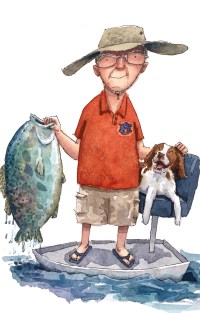
You Don’t Have to Go to Vermont
By Mickey Dunaway
Reprinted with Permission by Currents Magazine | DEC 2025| Cornelius, NC

Since Christmas last, I have thought of little in my spare moments, and if I am honest, in the minutes when I should have been doing other more husbandly things than fishing in the mountain trout streams of North Carolina. This young man’s pastime has not just occupied my old man’s time; it has demanded it. Only one other time in my life have I spent more energy on researching a single topic, and that was my dissertation days at Auburn.
Trout fishing is a simple thing—a limber rod, a reel filled with a heavy plastic coating over a braided line core. Fly lines must be able to cast a featherweight leader, and the end of a very thin monofilament leader is a fly tied to the leader or tippet (don’t ask what it is; you really don’t need to know). Simple. Right?
At its heart, all fishing is simple until it isn’t. There is an entire North Carolina economy, I have learned, built around $1000 rods and $600 reels filled with $125 fly line. And then there are the guides, who, for a half-thousand dollars, will show how and where the trophy fish lie in wait for a bit of hair and fur tied to a hook to imitate the current food that floats down past their noses. Some of those floaters or danglers are Wooly Buggers, Chubby Chernobyls, Griffith’s Gnats, Prince Nymphs, and San Juan Worms. There are the Hare’s Ear and Elk Hair Caddis. The Blue Wing Olive and the Zebra Midge. There are the Mops and Eggs, Eggs with San Juan Worms, and Royal Wulffs.
The home screen on my iMac is covered with the most popular ones, so I can become familiar with them when I read about them in my research, and I have several of each kind in my half dozen small, plastic tackle boxes. One can easily spend hundreds, and many spend thousands of dollars each season, in search of trophy brown, rainbow, or brook trout that inhabit North Carolina streams. One occurs naturally —the Brookie —and the Rainbow and Brown trout are there thanks to state stocking programs.
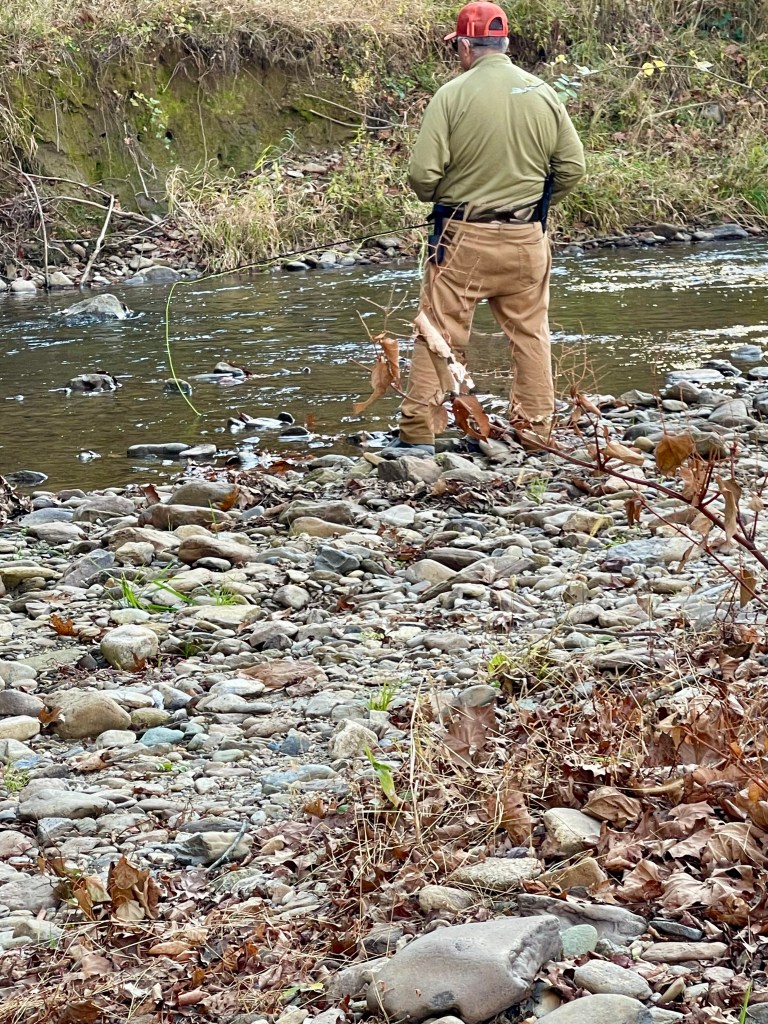
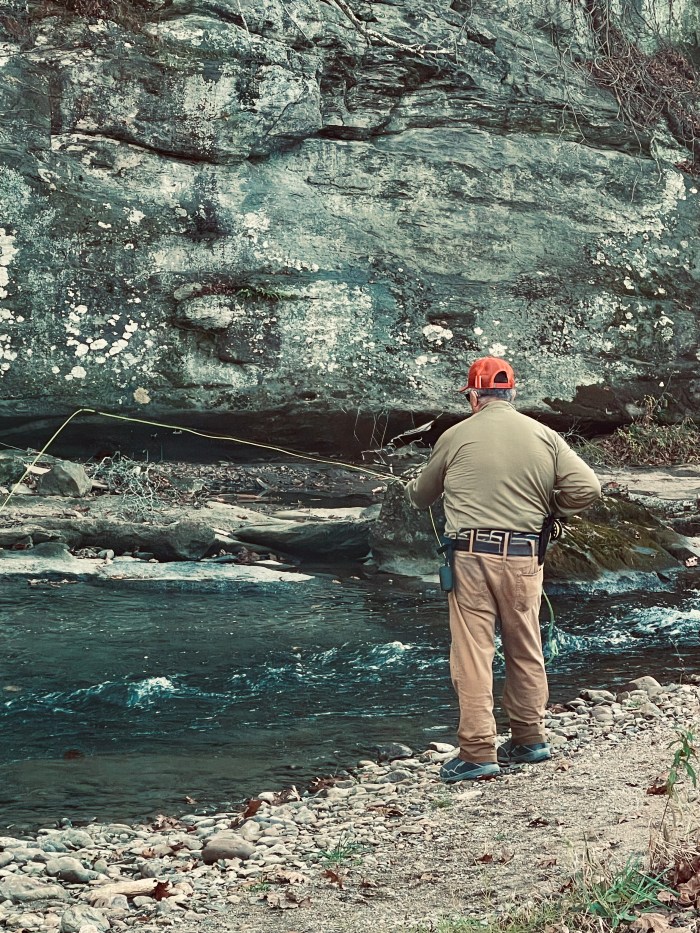
A few days ago, in the second week of November, my wife, Sandy, and I headed out on our own for the first time. We traveled northwest, two and a half hours from Cornelius to the small—and I mean small—zip code of Grassy Creek in Ashe County to fish on our own the well-regarded trout stream of Helton Creek.
To get to our destination, we traveled interstate and county highways and, best of all, the mountain county road that led us to Helton Creek. It had been many years since I had driven down a dirt and gravel road to find an ultimate fishing destination, and I loved it just as I did in my earlier days of fishing the Escatawpa River that borders Alabama and Mississippi.
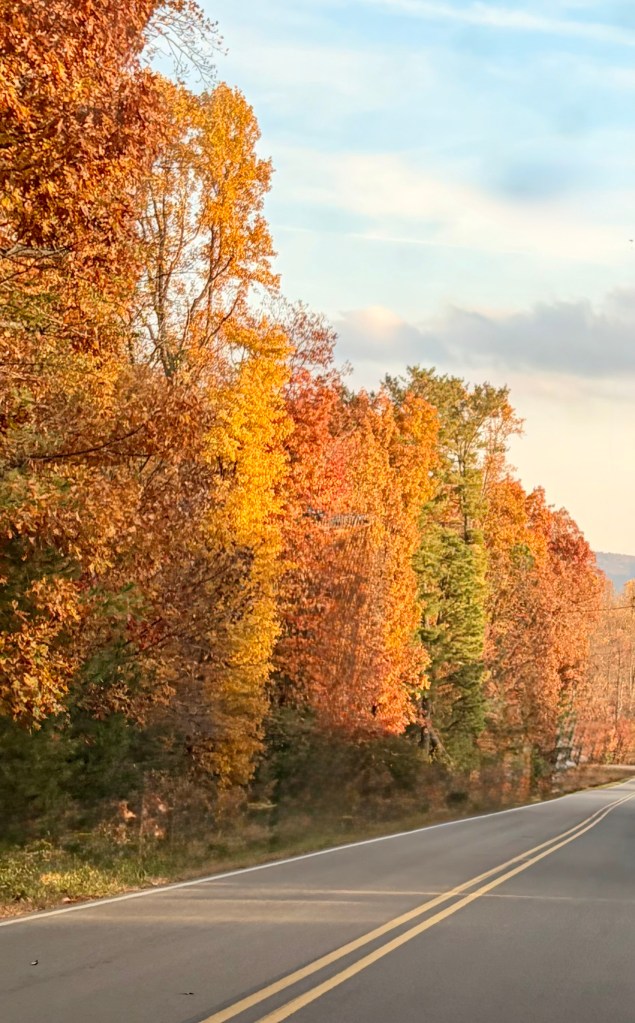
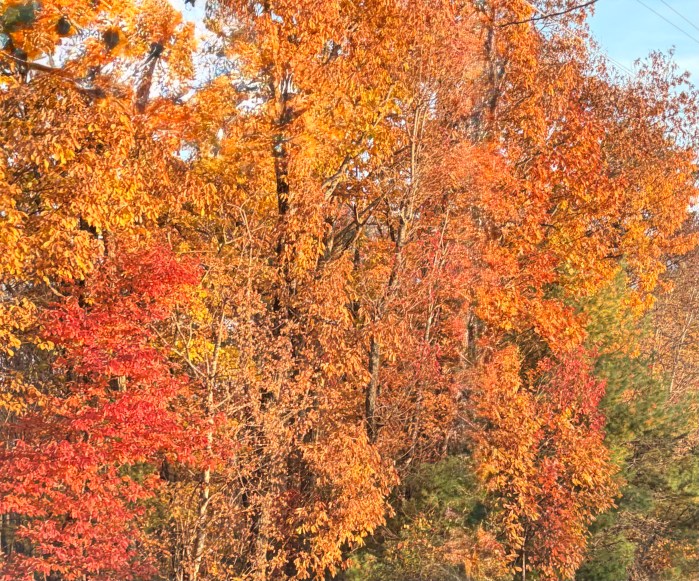
Though we caught not a single fish in Helton Creek, it was an enchanting trip spent with the fall colors of the mountain hardwoods that had surprisingly not yet dropped their leaves, as had the maple trees in my own neighborhood in Cornelius. Much to my delight, as we climbed the elevations of mountains, our engine straining a bit and tires working to hug the curvy roads, the colors flashed gloriously across the view of our windshield, just as the title of this month’s column also flashed across my mind. This is not Vermont or New Hampshire. This is my home state, and it is remarkable. Had we caught some trout —and those will come —it could not have
Before this initial fishing trip and as part of my trout-fishing research, we had scouted several other streams within a roughly two-hour drive of home. Stone Mountain Creek in Stone Mountain Park, Reddies River in Wilkesboro, and Ararat River in Mt. Airey.
We retraced our route home and talked about our encounters over the last few months. After 20 years of living and bass fishing in and around Charlotte, we had finally met the true North Carolina. As we walked the Wilkesboro Greenway that runs beside Reddies River, we were astounded to discover what must have been a hundred acres of the greenest cabbages we had ever seen.
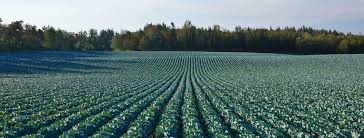
Those cabbages were a discovery, just as was the homeless veteran whose story we stopped to hear on the Mt. Airey Greenway next to the Ararat River. It was a sad tale we heard from this grizzled vet. Humble, surely penniless, a half-smoked, hand-rolled cigarette hanging from his chapped lips, he told us a story of being harassed for sleeping in his car. As easily as he told us about his misfortunes, his conversation turned to catching trout! That is how the humble trout equally entices the homeless man with a Walmart rod and reel as it does the owner of the must-have this year’s trout-fishing accoutrements.
Small towns, the brilliant, mottled colors of hardwoods on the mountain sides, and—of course, the brilliantly colored trout—define a large section of our adopted home, and we are excited that we have just begun to discover all its wonders.
Many men fish all their lives without ever realizing that it is not the fish they are after. Henry David Thoreau
 Southern Exposures