
Yes, Ma’am. No Ma’am
By Mickey Dunaway
Reprinted with Permission by Currents Magazine | September 2,2025 | Cornelius, NC.

In 1971, in my second summer as a high school teacher and basketball coach in Mobile, a fellow coach and friend asked me if I would be interested in making some extra summer dollars umpiring little league baseball games.
I jumped at the chance. After all, how hard could umpiring little league games really be? I had played baseball and softball every year I was in school. And I coached Freshman baseball my first two years at Mary Montgomery High School in Semmes, AL.
. . . . .
In my first game, I was umping at second base and, “Geez,” I thought, “this really is easy money.” I was so wrong. In the second game of that evening, I was behind the plate, and things went well once I got over thinking how likely it was going to be that this 10-year-old catcher might miss a pitch that would hit me below the bottom of the mask squarely in my “Adams apple.” As it turned out, the catcher was pretty good, and the pitcher couldn’t break a windowpane with his fastball.
. . . . .
The game moved on without incident until the bottom of the fifth inning. One inning left of a six-inning game. A runner was on third base. Two outs. Score tied. The pitcher threw a slow fastball, and the batter hit an easy roller back to the pitcher.
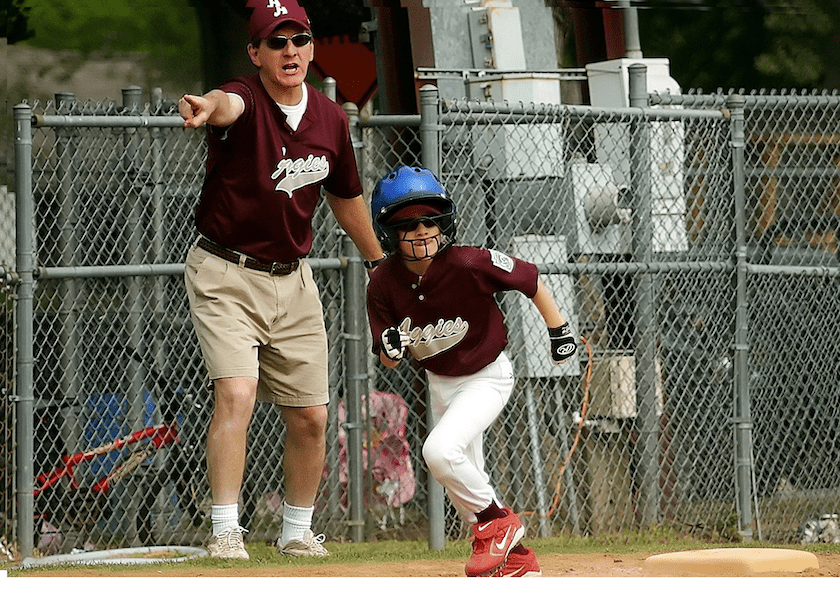
The coach at third base sent the runner. Running was not an accurate description of what the player at third actually did. He was only a foot off the base when the batter hit the ball back to the pitcher.
Not sure what to do, the kid looked at his third base coach, who was clapping his hands and yelling, “Go…go…go!” to his player on third. The runner’s hesitation meant he inevitably started out behind. It was going to be a close play at the plate as the pitcher fielded the ball and threw it to the catcher.
. . . . .
I anticipated a close play—slow runner starting late, pitcher with a rubber band arm, and a catcher who might or might not catch the throw from the pitcher. So, I moved from behind the catcher to get a clear view of the play at the plate.
The ball and the runner were moving at about the same speed. Not the easy call I hoped for, as the ball arrived maybe two seconds before the runner. The catcher applied the tag. I called the runner out. The catcher and pitcher ran back to their dugouts, celebrating.
The third base coach, who was also the manager of his team, began racing from his third base coaching box straight at me. Red-faced and yelling names at the top of his lungs—names I had never been called before and cannot repeat in a family column.
I managed to keep my composure. I placed my hands on my hips as the coach arrived inches from my face, plainly still irate. I looked the coach in the face and spoke to him in a voice just loud enough to be heard by the coach but not by the crazies in the crowd. I put my hand on his shoulder and whispered in his ear, “Coach, I might have made a bad call or two tonight, but I am about to make a good one.
You’re out of here. Now leave the dugout or the game is over.” That was the last little league game I ever called.
. . . . .
I have thought many times over the years about the unseasonable lesson that “coach” taught his 11- and 12-year-old kids that night.
These days, I see hundreds of coaches, players, fans, parents, and politicians acting out exactly the lesson that the coach taught his kids in that little league baseball game in 1971. Unfortunately, since 1971, such discourtesy and childish behavior have risen like the rate of inflation. Today, arguments are settled with weaponry in city streets and in school hallways. On January 6, 2021, threats, half-truths, and hatefulness made their ways to the halls of Congress. That day, our country was on the verge of anarchy. The United States of America.
What happened to common courtesy? Can we return to the rule of law? Where does the lack of civility end? How did we get to this point? How does it stop?
As a Teacher for 10 years, an Assistant Principal for five years, and a Principal for a dozen years, we clearly had rules of behavior. Still, one rule stood above them all: Be courteous…to fellow students, teachers, janitors, cafeteria workers, and administrators.
“Yes, Ma’am,” and “No Ma’am” remain two of the most potent words of respect and courteousness in the English Language.
. . . . .
“The line between the public life and the private life has been erased, due to the rapid decline of manners and courtesy. There is a certain crudeness and crassness that has suddenly become accepted behavior, even desirable.”
―Fannie Flagg, Southern Humorist
 Southern Exposures