Golden Grape of the South
By Mickey Dunaway | Reprinted with Permission by Currents Magazine | FEB 24 | Cornelius, NC.
If you have read my Southern Exposures essays, you likely know I was born and raised in very, very south Alabama. I was born in the small town of Brewton just north of the Alabama-Florida state line. Moved at some point early on (I am still searching for that date) and was raised through high school in the town of Wilmer just east of the Alabama-Mississippi line.
I grew up a country boy through and through. I had no choice. The woods and its bounty were my garden. For example, once I hit shotgun-carrying age—on the first day of squirrel season—my Mama, a schoolteacher, let me stay out of school that day. As I recall, the note to return to school the next day read, “David Michael had permission to go squirrel hunting yesterday.” Nothing about excusing me. No sir. She only used my formal Christian names when she was less than pleased with me. Of course, I had covered my tracks and asked my Daddy the night before if I could miss school, and as a hunter, too, he said, “Yes, I will tell Mama.” I am not real sure he told Mama.
_____
Our small home at the end of our sandy dirt road was surrounded by woods on three sides. Walk a hundred yards, and I was hunting and having fun growing up; I could be found hunting those woods from September to March.
Often, though, friends and I just walked those beautiful woods and sometimes brought back the fruit of our journeying. There was a panoply enough to fill a cornucopia in those woods: bullises, chinquapin nuts, huckleberries, and dewberries.
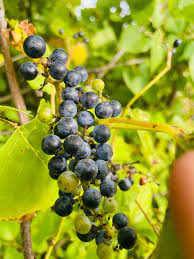


Dewberries are smaller, sweeter, with fewer seeds than blackberries, and, like their bigger northern cousin, often grow along roadsides and country lanes. Chinquapins grow in the open woods not far from water. They are a first cousin to the northern chestnut and are favorites of squirrels and deer. The nut is covered with spines so sharp that they must be removed with two sets of pliers when you get back home. The last of our forest fruit, the huckleberry, is the same as the Maine wild blueberry—both are cousins of the domesticated blueberry found in any supermarket, but smaller and tastier by far.
_____
From this point forward, I want to focus on favorite of all southerners—the muscadine or Vitis rotundifolia—a species of grape native to the southeast and south-central United States. Its range has grown during its 400-hundred-year reign as America’s Grape into Florida to the New Jersey coast and west to eastern Texas and Oklahoma, according to the U.S. Department of Agriculture.
Where did this muscadine vine begin that could continue to grow thrive and multiply across states after 400 years? That is the heart of Mother Nature’s Remarkable Love Story for February. All grapes, native to America,began on the Outer Banks on Roanoke Island, North Carolina. So those bullises I picked and ate while walking the south Alabama woods came from the Mother Vine—probably transported from North Carolina by native Americans.
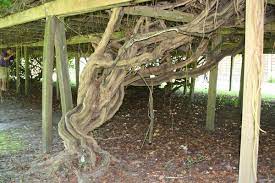
According to Wikipedia, the Roanoke Island Mother Vine is estimated to be at least 400 years old and was probably brought to Roanoke Island by Algonquian-speaking peoples. Other historians think it was brought by explorers who landed on Roanoke about the same time as the Lost Colony of Roanoke.
Regardless of its source, the Mother Vine of February 2024 is the same vine that produced scuppernongs on Roanoke Island in the early 1600s.
As a backyard gardener who will struggle with growing a tomato plant this summer, I am amazed that this wonder of nature that has survived droughts, floods, hurricanes, pirates, and wars.
I have walked among the towering redwoods in Muir Woods, California, and the fruited woods of Alabama that raised me as a child to love nature, but nothing surpasses Mother Vine of the Outer Banks of North Carolina.
_____
I hope you can drive this spring to visit the Outer Banks and the Mother Vine, and when you do, stop along the way, and enjoy a muscadine slushy at most any local gas station. And before you return home, bring several varieties of muscadine wine produced by our state’s other wineries.
I admit that I am not a wine aficionado—remember my Alabama background—and when asked about my favorite wine, I usually respond, “Well, to tell you the truth, I like to taste the grapes, and nothing does that as well as North Carolina muscadine wine.
_____
Wine is constant proof that God loves us and loves to see us happy.
– Ben Franklin
 Southern Exposures
I so loved living on the Outer Banks. So much so that the day the moving van showed up, I literally cried when I pulled into the driveway. As far as making muscadine wine, let me know when you want to learn. My late mother in law (from North Alabama) taught me (also from South, South Alabama) how to make that wine the old fashioned way, among so many other things in life that sadly, are disappearing, or have totally been forgotten in this too fast-paced world of ours.
P.S. You forgot to say that we were raised STRICT Southern Baptists or Methodists and drinking was just as bad, if not worse, than breaking any of the ten commandments and drinking would get you a fast-tracked ticket straight to, well, you know where, or so our mothers told us….
LikeLike